
Barista Control Strip - the Future of Espresso Machine Design
The commercial espresso machine sector is currently navigating an identity crisis. On one side, the aesthetic demands of the "Third Wave" coffee movement are pushing for Low-Profile Design—sleek, under-counter machines that remove the "wall of steel" barrier between the barista and the customer. On the other side, the technical demand for Precision Data (pressure profiling, gravimetric yield, flow rates) requires larger, more complex displays to visualize this information in real-time.
This creates a geometric conflict: How do you fit more data onto a machine with less vertical surface area? For many manufacturers, the stopgap solution has been the consumer tablet—typically an iPad or Android device mounted on a stand. But in the harsh reality of a commercial kitchen, this compromise is proving to be a liability.
The Failure of Consumer Electronics in the "Hot Zone"
To understand why industrial-grade displays are necessary, let's analyze the physical environment of an espresso machine. It is one of the most hostile environments for electronics outside of heavy industry.
1. The Thermal Wall
Espresso machines are massive thermal batteries. Steam boilers operate at approximately 1.2 to 1.5 bar, creating internal temperatures between 120°C and 127°C. The top surface of the machine functions as a passive cup warmer, often exceeding 50°C.
Consumer tablets are typically rated for an operating range of only 0°C to 35°C. When placed in this "hot zone," they suffer from Thermal Throttling: the screen dims aggressively to reduce heat generation, making it unreadable in a sunlit café. Eventually, the device shuts down completely to prevent battery failure. A machine that relies on a tablet for control becomes a brick.
2. The "Ghost Touch" Phenomenon
Modern machines feature "Auto Steam Flush" cycles, releasing bursts of steam near the group head. When this steam condenses on a consumer capacitive screen, the water droplets bridge the sensor’s electrostatic field. Because consumer touch controllers are tuned for dry environments, they often register these droplets as finger inputs. This results in "Ghost Touches"—the machine accidentally changing a recipe or aborting a shot because of humidity.
3. Supply Chain Instability
Designing a chassis around a specific consumer tablet is a risky long-term strategy. Consumer tech cycles are rapid; a change in bezel size by just 2mm in the next model year can render your expensive stainless steel tooling obsolete.
The Industrial Solution: Topway HMT088ATA-D
The future of espresso machine interfaces is not a square tablet; it is the Bar-Type Smart LCD.
The Topway HMT088ATA-D is an industrial Smart TFT Module designed specifically to solve the geometric and environmental challenges of modern appliances.
The "Barista Control Strip" Form Factor
With a resolution of 1920x480 pixels, the HMT088ATA-D features an ultra-wide 4:1 aspect ratio. This form factor maps perfectly to the "forehead" of a low-profile machine—the narrow horizontal strip directly above the group heads.
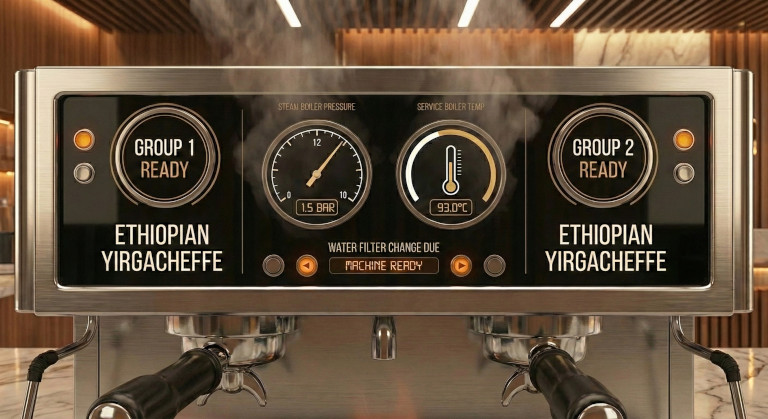
This aspect ratio allows for a split-zone interface layout, which aligns data with physical hardware:
- Left Zone: Displays the shot timer and pressure graph for Group 1, directly above the group handler.
- Center Zone: Displays global telemetry like steam boiler pressure and temperature.
- Right Zone: Mirrors controls for Group 2.
This 1:1 mapping reduces the barista's cognitive load, allowing them monitor the shot without looking away at a contral screen.
Industrial Reliability
Unlike consumer devices, the HMT088ATA-D is built for the kitchen:
- Temperature Resilience: Rated for an operating range of -20°C to +70°C, it withstands the heat soak from steam boilers without dimming or shutting down.
- EMI Immunity: Espresso machines generate significant Electromagnetic Interference (EMI) from high-amperage heating elements and rotary pumps. The Topway module utilizes an RS232 interface. Which uses high-voltage swing signaling that is exceptionally robust against electrical noise.
- Water Rejection: The industrial touch controller can be tuned to distinguish between the static capacitance of water droplets and the focused capacitance of a finger, eliminating "ghost touch" issues.
Architecture: Distributed Processing for Fluid UI
In a traditional architecture, the espresso machine's main microcontroller (MCU) is often overburdened. It must maintain PID temperature stability, while simultaneously trying to render complex graphics. This risks "thread blocking," where a complex screen animation could cause the MCU to miss a temperature sensor reading.
The Topway Smart LCD uses a Distributed Processing Architecture. The display module itself is an embedded system with its own 32-bit processor and Graphics Engine.
- The Main Board's Job: It simply sends a lightweight command via UART, such as VP_Write(0x100, 935) (Set Variable 0x100 to 93.5).
- The Smart LCD's Job: It receives the command and handles all the heavy lifting—rendering the needle movement, anti-aliasing the text, refreshing the screen and responding user's touch event.
This ensures the user interface remains fluid and responsive (60fps) without compromising the critical control loops of the machine.
Conclusion
The "Third Wave" of coffee demands equipment that is both beautiful and reliable. The reliance on consumer tablets is a transitional phase that is proving unsustainable.
By adopting the Topway HMT088ATA-D, manufacturers can bridge the gap between aesthetics and engineering. It allows for a "Barista Control Strip" that disappears into the machine's design until lit, offering the data density of a tablet with the rugged reliability of an industrial component.
Ready to upgrade your HMI? Download the HMT088ATA-D Specification Sheet and try our Zero-Code UI Editor to start prototyping your next-generation interface today.