
Choosing a TFT Display with SPI Interface for Your Embedded System
Selecting the right display for an embedded system is a critical design choice that impacts everything from hardware complexity to user experience. While high-speed interfaces like RGB or MIPI are powerful, they often come with a high pin count and increased complexity. For a huge range of applications, a TFT display with an SPI interface for embedded systems offers the perfect balance of performance, simplicity, and cost-effectiveness.
But how do you know if an SPI TFT is the right choice for your project? This guide will walk you through the benefits, key technical considerations, and how to select the perfect display for your needs.
What is an SPI Interface?
SPI, or Serial Peripheral Interface, is a simple and versatile synchronous serial communication protocol. It uses a master-slave architecture with just a few wires, making it a favorite among embedded engineers.
A standard SPI connection requires only four signal lines:
- SCLK (Serial Clock): The clock signal that synchronizes data transfer, driven by the master.
- MOSI (Master Out, Slave In): The data line from the master to the slave.
- MISO (Master In, Slave Out): The data line from the slave back to the master.
- CS (Chip Select): Allows the master to select which slave device it wants to communicate with.
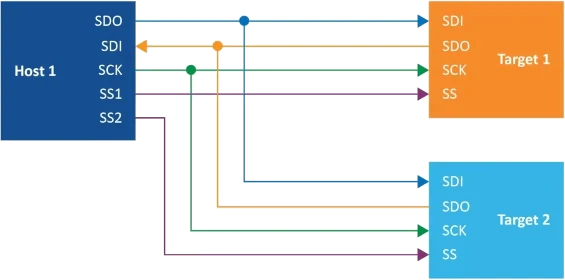
This straightforward setup is one of the primary reasons it's a go-to interface for connecting peripherals like sensors, memory chips, and of course, LCD displays.
Why Choose a TFT Display with an SPI Interface?
When you're designing a compact or cost-sensitive embedded system, every component and every pin on your microcontroller (MCU) counts. This is where SPI shines. There are 4 key benefits, for using SPI interface in your embedded system.
1. Extremely Low Pin Count
Compared to parallel interfaces that can require 8, 16, or even 24 data lines plus control signals, SPI needs just 3 or 4 pins. This frees up valuable GPIOs on your MCU for other tasks, simplifies your PCB layout, and reduces potential points of failure.
2. Simple Protocol and Wide MCU Support
The SPI protocol is far less complex than high-speed differential interfaces. The software overhead is minimal, and virtually every microcontroller on the market—from tiny 8-bit MCUs to powerful 32-bit processors—has at least one built-in SPI hardware peripheral. This makes driver development faster and firmware easier to manage.
3. Cost-Effectiveness
Fewer pins and simpler routing directly translate to lower costs. A 2-layer PCB is often sufficient for an SPI-based design, whereas more complex interfaces may require a more expensive 4-layer board to manage signal integrity.
4. Sufficient Speed for Most HMI Applications
While not as fast as parallel or MIPI interfaces, modern SPI clock speeds (often running at 20-80 MHz) are more than capable of handling the graphical demands of most embedded products. For devices that require displaying sensor data, status menus, or simple user interfaces, SPI provides smooth updates without the hardware overhead.
Key Considerations When Selecting an SPI TFT Display
Choosing an SPI display interface for an embedded system is primarily a trade-off analysis between bandwidth (frame rate) and GPIO resource availability.
1. The "Go/No-Go" Bandwidth Calculation
While SPI saves pins, it introduces a hard throughput bottleneck. We need to verify SPI can drive your target resolution at an acceptable frame rate.
The Formula:
Required Bandwidth = Width x Height x Bits Per Pixel x Frame Rate
Example:
Display: 320x240; Color: 16-bit; FPS: 30Hz
320 x 240 x 16 x 30 ≈ 36.8 Mbps
The Bottleneck:
Standard SPI maxes out at around 40~80MHz. You can barely drive a 320x240 screen at 30 FPS on a standard 1-bit SPI bus. For anything larger (480x320 or 800x480), standard SPI will result in visible tearing or slow "curtain-effect" refreshing unless you use advanced techniques.
2. Select the Specific SPI Variation
If your pin count is tight but you need more speed, move up the tier list:
| Interface Variant | Data Lines | Bandwidth Multiplier | Typical Controller | Best For |
| Standard SPI | 1(MOSI) | 1x | ILI9341, ST7789 | <3.5", static UI, minimal video |
| Dual SPI | 2 | 2x | ST7789 | 3.5~4", faster UI transition |
| Quad SPI | 4 | 4x | GC9A01, ST7796 | High-res, >4" screens |
| Octo SPI | 8 | 8x | LPC5536 | Near parallel performance |
3. Controller Architecture: RAM vs. RAM-less
This is the most critical architectural decision for the software driver.
- Integrated GRAM: The display module has its own frame buffer (e.g., ILI9341).
Pros: MCU only sends changes (partial refresh). You don't need to refresh the whole screen 60 times a second. SPI is perfectly fine for high-res screens if the UI is mostly static (e.g., industrial control panels).
Cons: Tearing can occur if you write to GRAM while the screen is rastering. Crucial: Ensure the display exposes the TE (Tearing Effect) pin so your MCU can sync updates with V-Sync. - RAM-less (DPI/RGB passthrough): The display expects a constant stream of pixel data.
Do not use standard SPI for this. SPI cannot maintain the constant data stream required to prevent the screen from fading out. These displays require RGB (Parallel) or MIPI interfaces.
Summary Checklist for Selection
- Resolution Cap: Are your screen under 480x320? -> SPI is safe.
- Partial Refresh: Is your UI static (buttons/text)? -> SPI is safe even at higher resolutions (up to 800x480) if using a controller with GRAM.
- Video: Do you need full-screen video playback? -> Avoid SPI; use QSPI or Parallel.
- DMA Channel: Does your MCU (e.g., STM32) have a free DMA channel? SPI without DMA is CPU-blocking and inefficient.
Find Your Perfect SPI TFT Display with Topway
A TFT display with an SPI interface for embedded systems is a robust, cost-effective, and reliable choice for countless industrial, medical, and commercial products. But the success of your project depends on a supplier who understands the technical nuances and can provide a high-quality, dependable module.
At Topway, we have over three decades of experience in manufacturing a wide range of TFT displays with SPI and other interfaces. Our engineering team can help you navigate the technical trade-offs and select the perfect display that meets your performance, power, and cost targets.
Ready to simplify your next embedded design? Explore our range of TFT Display Modules or contact our team today for a personalized consultation.